
With the introduction of the European Accessibility Act (EAA, Directive (EU) 2019/882), all businesses in the European Union, including Bulgaria, are faced with a new reality: accessibility is no longer optional, but mandatory. Specifically for e-commerce, this means a major transformation in the way online stores design their websites.
What does the European Accessibility Act require?
The act requires consideration of the needs of people with disabilities, including visual, hearing, motor or cognitive disabilities. According to Art. 2.1 of the Directive, it covers “electronic commerce services” — that is, online shops. According to Art. 3, paragraph 10, it must be ensured that digital interfaces are as accessible as possible to the widest possible range of users, including by supporting technologies such as screen readers, keyboard navigation, etc.
Basic requirements for online stores:
-
Text equivalent of visual content — alternative text (alt text) for images.
-
Keyboard accessibility — all functions must be able to be used without a mouse.
-
Clear and understandable language — avoiding complex or confusing wording.
-
Control over time-limited tasks — e.g. timers in the checkout process.
-
Contrast and colors — minimum contrast requirements between text and background to ensure readability.
-
Navigation and structured content — properly marked up headings (H1, H2…), clear menus, and logical navigation.
All these requirements are tied to EN 301 549 — the European standard for accessibility of ICT products and services, which is mandatory to comply with.
What does this mean for Bulgarian online stores?
By June 28, 2025, all new e-commerce websites in the EU, including Bulgaria, must be fully compliant with the EAA. Existing stores are given an additional transition period — they must comply by June 28, 2030
Important: Penalties for non-compliance are not symbolic. According to the Consumer Protection Act (CPA) and the upcoming changes in national legislation that will transpose the EAA, the Consumer Protection Commission (CPC) will have the right to impose fines of up to 10,000 BGN per violation, and in case of systematic non-compliance - even more.
The imposition of new web accessibility requirements will also have a serious impact on popular open source e-commerce solutions, such as Opencart and Prestashop, which are also widely used on the Bulgarian market.
OpenCart is inherently a very flexible platform, but its standard templates do not fully comply with the accessibility requirements set out in EAA and the EN 301 549. This means:
-
Many of the existing themes have not been tested for screen readers or keyboard navigation.
-
Some extensions (modules) may violate accessibility principles, for example through inappropriate text color or lack of alternative text for images.
-
Lack of controlled timings and optional introduction of standard ARIA navigation attributes.
Opencart store owners should choose accessible themes or modify their existing themes to WCAG 2.1 AA standards. It is also recommended to perform a full accessibility audit of custom modules and the checkout process.
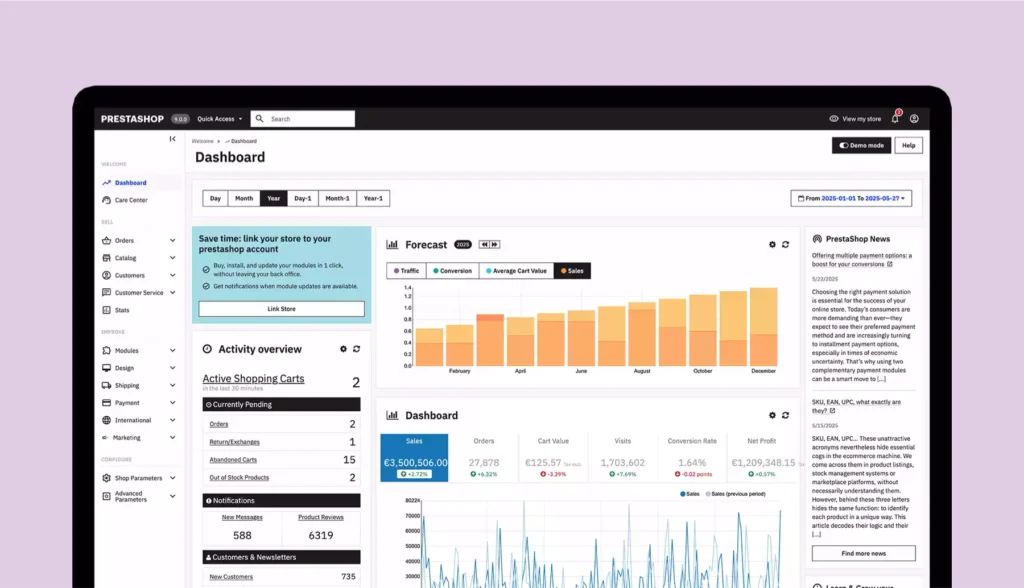
Prestashop has a stronger commitment to accessibility in its latest versions, but:
-
The default theme is not fully compatible without modifications.
-
Many merchants use external themes that are not certified for accessibility.
-
The checkout process in some modules remains difficult for users with motor or visual impairments.
Store owners must:
-
Choose a theme that is designed with accessibility in mind, or adapt the current one.
-
They check modules for functionalities such as easy keyboard navigation and screen reader support.
-
They are investing in redesigning key pages such as product pages and the checkout form for improved accessibility.
The consequences of non-compliance:
-
Fines and sanctions — administrative penalties that can become serious in case of recurrence.
-
Loss of customers — over 15% of the EU population has permanent disabilities. An online store without accessibility automatically loses these customers.
-
Reputational risk — brands that are not socially responsible are increasingly being boycotted by consumers.
-
Loss of competitiveness — European regulations create a new standard that will be expected by all serious customers.
What to do if you are an online store owner?
Analyze your existing site — perform an accessibility audit against WCAG 2.1 AA (Web Content Accessibility Guidelines).
Pay attention to UX/UI design — it should meet specific accessibility requirements.
Invest in automated verification tools
Sources: